IRIN hat geschrieben:EGYPT: Timeline of key events since Mubarak's departure
After 18 days of mass protests, Husni Mubarak resigned as president on 11 February, ending 30 years of autocratic rule. A Supreme Military Council took over, pledging to work for a smooth transition to civilian rule. Two months on, however, protests are continuing in Cairo's Tahrir Square to demand the removal of remaining figures in the old regime, and the prosecution of Mubarak and his family for corruption and violence against protesters in the early days of the uprising. A timeline of key events since Mubarak's ouster follows:
11 February: Omar Suleiman, then vice-president, announces that Mubarak has resigned as president and handed over power to the army, leading to celebrations in Tahrir Square.
12 February: The new military command promises to hand power to an elected government and confirms Egypt's commitment to all international treaties, in response to Israeli concerns about the future of its 1979 peace treaty with Egypt. Travel bans are imposed on several members of the former regime.
13 February: Police, public and private sector workers and bank employees organize large-scale demonstrations in Cairo, Alexandria and other cities demanding better wages. Rallies also attempt to clear the police's name after its use of force against protesters earlier.
14 February: The military command issues "Communiqué No 5", calling for national solidarity, condemning the demonstrations and urging workers to help restore the economy.
18 February: "Victory Friday": Hundreds of thousands go out onto the streets of Cairo to celebrate a week since Mubarak's departure. Tens of thousands of Egyptian migrant workers in Libya begin to return home amid concerns over the economic impact.
2 March: A constitutional referendum is tentatively scheduled for 19 March.
3 March: Prime Minister Ahmed Shafik steps down a day ahead of protests planned against him. Essam Sharaf is appointed as the new prime minister.
5 March: Protesters raid several State Security Investigations (SSI) offices across Egypt, including the headquarters in Alexandria - reportedly in a bid to secure documents believed to include evidence of crimes committed by the SSI against citizens during Mubarak's rule.
19 March: Constitutional referendum takes place in what the government says is a record turnout - with 41 percent of the 45 million eligible voters taking part.
22 March: Part of Interior Ministry building catches fire during police demonstrations outside it.
23 March: New law announced criminalizing protests and strikes: Anyone organizing or calling for a protest will be sentenced to jail and/or fined US$100,000.
29 March: Military Council announces postponement of parliamentary elections until September 2011, to give opposition leaders time to organize political parties.
31 March: Egypt is urged by groups, including Amnesty International, to scrap new law banning protests and strikes.
1 April: "Save the Revolution" day. Tens of thousands stage demonstration to demand quick action by the ruling Military Council to dismantle remains of the old regime.
5 April: A delegation of the Office of the UN High Commissioner for Human Rights encourages the Military Council to move towards democratic reform, and calls for further efforts to combat human rights violations and impunity.
8 April: "Friday of Cleansing": Tens of thousands gather in Tahrir Square for the largest protests in weeks. Protesters renew their demand for a new constitution, the removal of Egypt's Emergency Law (first implemented in 1958), an end to military rule, the removal of any military personnel associated with Mubarak's regime, and prosecution of Mubarak and his family.
9 April: Protesters demand trial of Mubarak and other officials allegedly involved in corruption and human rights violations. Security forces open fire on protesters in Tahrir Square, killing at least two and injuring dozens. The crackdown is the most brutal since the military started running the country on 11 February. Amnesty International condemns excessive use of force by the army.
10 April: An Egyptian blogger is sentenced to three years in prison for criticizing the military. Human rights advocates see the incident as a violation of hard-won freedom of expression. Mubarak, speaking to Al Arabiya TV, denies corruption allegations against him and his family.
11 April: Ahmed Nazif, former prime minister of Egypt (2004-2011), called in for questioning on corruption allegations.
13 April: Mubarak and his two sons placed under 15-day detention in connection with corruption and state violence allegations. The sons are transferred to Cairo's Tora prison, while Mubarak remains under detention in hospital, following health problems.
Sources: Amnesty International, Human Rights Watch, International Organization for Migration, Office for the Coordination of Humanitarian Affairs, Office of the UN High Commissioner for Human Rights
The one who follows the crowd will usually go no further than the crowd. Those who walk alone are likely to find themselves in places no one has ever been before.
Hallo zusammen,
...und wieder ist ein grosser Schritt in die richtige Richtung getan: die NDP wurde aufgeloest!
Der "nette" Nebeneffekt ist, dass die Wahlvorteile, die die NDP bei schnellen Neuwahlen gehabt haette, nun dahin sind. Es muss sich eine neue Partei gruenden...und die muss erst einmal Gelder beschaffen
Hunderte islamistische Hardliner und Anhänger der Muslimbruderschaft haben am Sonntag in Ägypten mit der Blockade von Schienen und Straßen gegen die Ernennung eines koptischen Christen zum Gouverneur protestiert. mehr...
Grüsse
Alexander
The one who follows the crowd will usually go no further than the crowd. Those who walk alone are likely to find themselves in places no one has ever been before.
Bei den knapp dreiwöchigen Unruhen in Ägypten kamen einem neuen Bericht zufolge mehr als doppelt so viele Menschen ums Leben, wie bisher angenommen. mehr...
Grüsse
Alexander
The one who follows the crowd will usually go no further than the crowd. Those who walk alone are likely to find themselves in places no one has ever been before.
Hi Alexander,
das mit dem Gouverneur in Qena hat nicht wirklich nur etwas damit zu tun, dass er Kopte ist! Es gab wohl diverse andere Gruende! Leider nimmt die internationale Presse gerne die "Koptenverfolgung" zum Anlass, solche Meldungen herauszugeben. Es gab - soweit mir bekannt - bisher 2 koptische Gouverneure dort...
Im Laufe des Tages werde ich noch Quellen dazu bringen - konnte mich nur nicht bremsen das klarzustellen!
Schoenen Tag
Gruesse aus Baharia
Stefanie
Voltaire: „Ich mag verdammen, was Du sagst, aber ich werde mein Leben dafür einsetzen, dass Du es sagen darfst.“
...und noch etwas:
ist es wiklich wichtig, wieviele Menschen bei den "Unruhen" starben???
Jeder ist einer zuviel! Klar!Allerdings haben "wir" die Situation in Aegypten - Allhamdullilah - in den Griff bekommen (soweit). Und die Verursacher sind soweit auch bekannt und sie werden zur Verantwortung gezogen werden. Familien der Getoeteten bekommen finanzielle Unterstuetzung ...
Es gibt meiner Meinung nach wichtigere Themen als Zahlen ueber Getoetete!!!
Sorry, aber mir geht langsam die recht einseitige Berichterstattung bei manchen Themen im "westlichen Ausland" auf den Senkel! Nicht nur das aegyptische Staatsfernsehen hat die Menschen manipuliert!!!!
Gruesse aus Baharia
Stefanie
Voltaire: „Ich mag verdammen, was Du sagst, aber ich werde mein Leben dafür einsetzen, dass Du es sagen darfst.“
Hier nun meine Infos bezueglich der Proteste gegen den Gouverneur von Qena:
Zuerst ein Artikel aus der HP der Moslembrueder (ikhwanweb.com) http://ikhwanweb.com/print.php?id=28413
Approximately 5000 protestors however demonstrated for the second day in a row against the newly appointed Governor of Qena in Upper Egypt, General Emad Shehata Michael who was the head of the general bureau for investigating tax evasion. The protestors accused the new Governor of being a part of the former Mubarak regime.
Was mir bei der bisherigen Suche auffaellt, dass vor allem kirchliche Seiten darauf hinweisen, dass es ein Kopte ist. In Aegypten selber scheint es niemanden zu interessieren, ob Christ oder Moslem!
Was bei der Situation im Moment erschwerden hinzukommet ist, dass die Salafisten schwer aktiv geworden sind - und dahin passen auch dann propagandistische Aussagen zu Kopten. Dass Assiut/Qena schon seit vielen Jahren ein Brennpunkt ist, laesst sich nicht verlaeugnen. Doch muss man bei Beichten ueber die Proteste alle Facetten sehen!
Gruesse aus Baharia
Stefanie
Voltaire: „Ich mag verdammen, was Du sagst, aber ich werde mein Leben dafür einsetzen, dass Du es sagen darfst.“
Sorry - vergessen!
Zumindest der Vorgaenger im Amt des Gouverneurs (so weiss sogar der Vatikan!) war Kopte.
Ägypten
Muslime im südlichen Landesteil protestieren weiterhin gegen einen neuernannten Gouverneur, der koptischer Christ ist. Vermittlungsversuche des neuen Innenministers Mansur al-Eissawi, der aus der Region stammt, sind fehlgeschlagen. Nach Angaben der Nachrichtenagentur AP werden die Proteste in Quena von Salafiten angeführt, einer Gruppe von extrem konservativen Muslimen. Sie argumentieren, der Gouverneur könne als Christ nicht die richtige Anwendung des islamischen Rechts garantieren. Die Proteste bestehen vor allem in Sitzstreiks auf Bahngleisen und in der Blockade wichtiger Straßen. Auch der Vorgänger des jetzt ernannten Gouverneurs war schon ein koptischer Christ – nur hatte ihn noch der damalige Präsident Hosni Mubarak ernannt, der am 11. Februar diesen Jahres gestürzt wurde. (ap)
Ich gebe meine Suche nach weiteren Kopten dort auf...Habe anderes zu tun!
Gruesse aus Baharia
Stefanie
Voltaire: „Ich mag verdammen, was Du sagst, aber ich werde mein Leben dafür einsetzen, dass Du es sagen darfst.“
Jetzt habe ich doch noch einen lesenswerten Artikel gefunden. Er beschreibt sehr schoen die vielen unterschiedlichen Befindlichkeiten, die zu den Protesten in Qena gefuehrt haben. Er zeigt meines Erachtens sehr gut, dass man auf die Schwarz-Weiss-Maleirei verzichten muss, wenn man sich ernsthaft mit der politischen Situation (nicht nur) in Aegypten beschaeftigen will. http://www.almasryalyoum.com/en/node/405256
Fuer mich, die ich hier nun schon sehr lange lebe, ist der letzte Satz besonders wichtig: sie (die Regierung) hat das getan(schon wieder einen koptischen Gouverneur in Qena einzusetzten) ohne sie vorher zu fragen!
Seit dem 25. Januar wollen die Aegypter gefragt werden - und das ist gut so und ihr gutes Recht!
Gruesse aus Baharia
Stefanie
Voltaire: „Ich mag verdammen, was Du sagst, aber ich werde mein Leben dafür einsetzen, dass Du es sagen darfst.“
Fuer Interessierte, ueber was so im Moment in Aegypten in den Zeitungen berichtet wird, und wie - hier die woechentliche Zusammenfassung der Mittwochs-Zeitungen durch Al Masr-Alyoum. Ich persoenlich finde diese Einrichtung immer ganz spannend - ist auch noch recht neu, gibt aber einen guten Ueberblick:
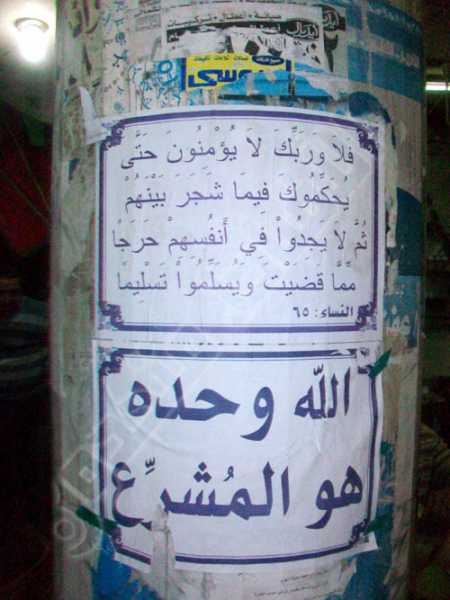
Weiss jemand, was auf diesem Plakat zu lesen steht?
Es stammt aus einem islamistischen Forum und das Foto soll in Alexandria aufgenommen worden sein. Angeblich wird auf dem Plakat zur Gründung eines islamischen Staates (wenn ich die Googleübersetzung richtig interpretiere) mit islamischen Recht aufgerufen.
Spread in the streets of Alexandria and fields of Islamic slogans and banners urging Egypt to convert to a religious state, through the application of Islamic law in various spheres of life.
Grüsse
Alexander
The one who follows the crowd will usually go no further than the crowd. Those who walk alone are likely to find themselves in places no one has ever been before.
The one who follows the crowd will usually go no further than the crowd. Those who walk alone are likely to find themselves in places no one has ever been before.